Succint! makes maintenance and spare-parts decisions autonomously, across every team involved — running invisibly on top of the systems you already have. Every decision it executes trains the engine that makes the next one.
One site. One workshop. One day. Free of charge, with no obligation to go further.
Every supply chain runs on decisions about what to stock, when to buy and what to do when something breaks. Those decisions sit with teams reading incomplete data in disconnected systems, with no shared intelligence and no automation.
Knows which assets can't fail
Schedules the work
Owns min/max and stock
Owns suppliers and lead times
Owns the line that stops
Owns the budget that absorbs it
Six roles. Six systems. One decision. No shared intelligence.
So critical parts run out, disruptions arrive as surprises, and every fix is reactive — resolved by a person, on a call, from memory.
Three proprietary layers, running underneath the software your teams already use. Without the map in the middle, AI is just guessing.
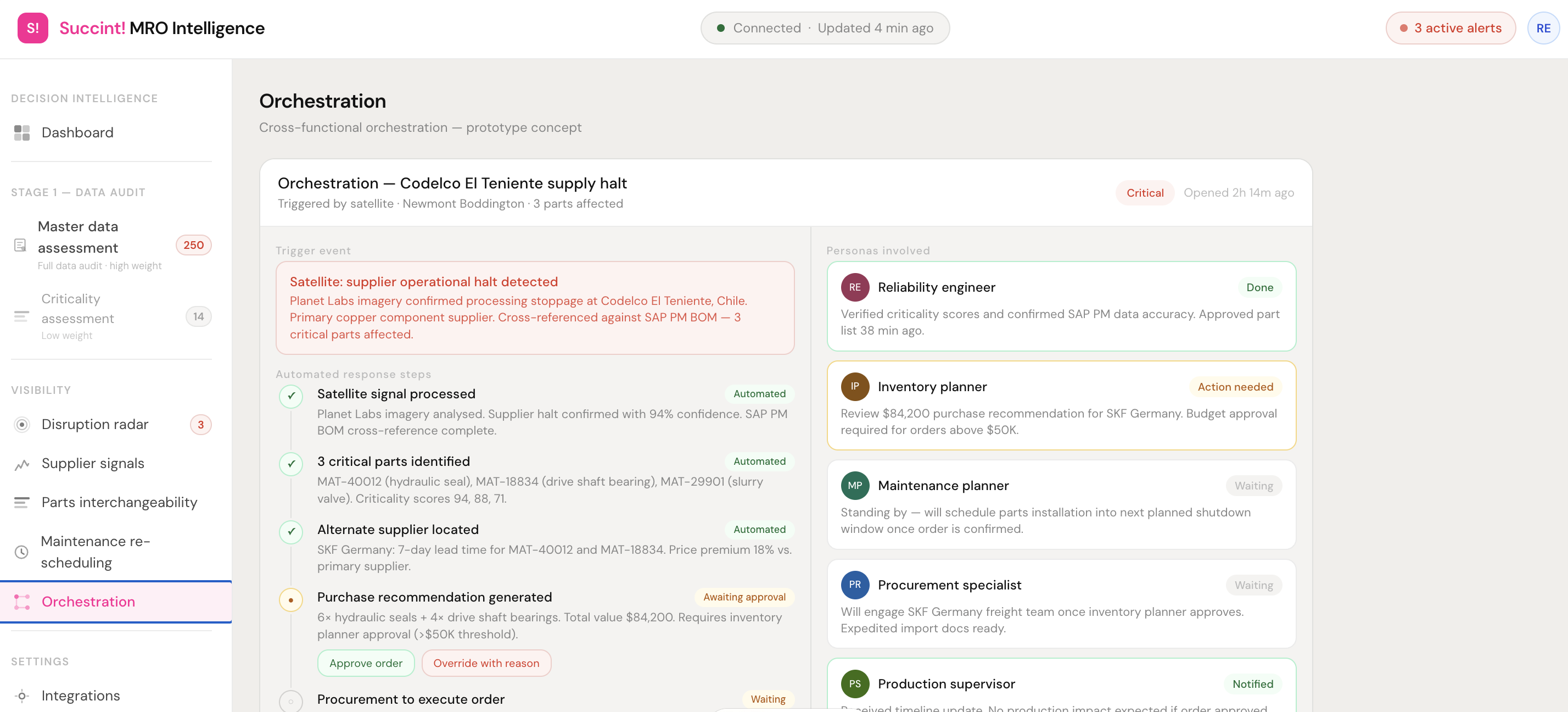
Humans approve decisions today; routine decisions execute themselves as confidence builds. Exceptions stay human. Every decision is logged, training the models on your operation — not a generic industry average.
Proprietary optimisation models compute the best decision, auditable and explainable. AI interprets the messy reality around it. Agentic AI orchestrates the workflow across every team involved.
Assets, parts, failures and decisions harmonised into one semantic layer, with the remediation engine that makes messy enterprise data solvable at all. The foundation every use case reuses.
System of record and execution. We are not replacing your ERP or your planning tool — recommendations flow back into the processes you already run.
Commodity infrastructure underneath, licensed solvers where they exist — the three layers above are ours.
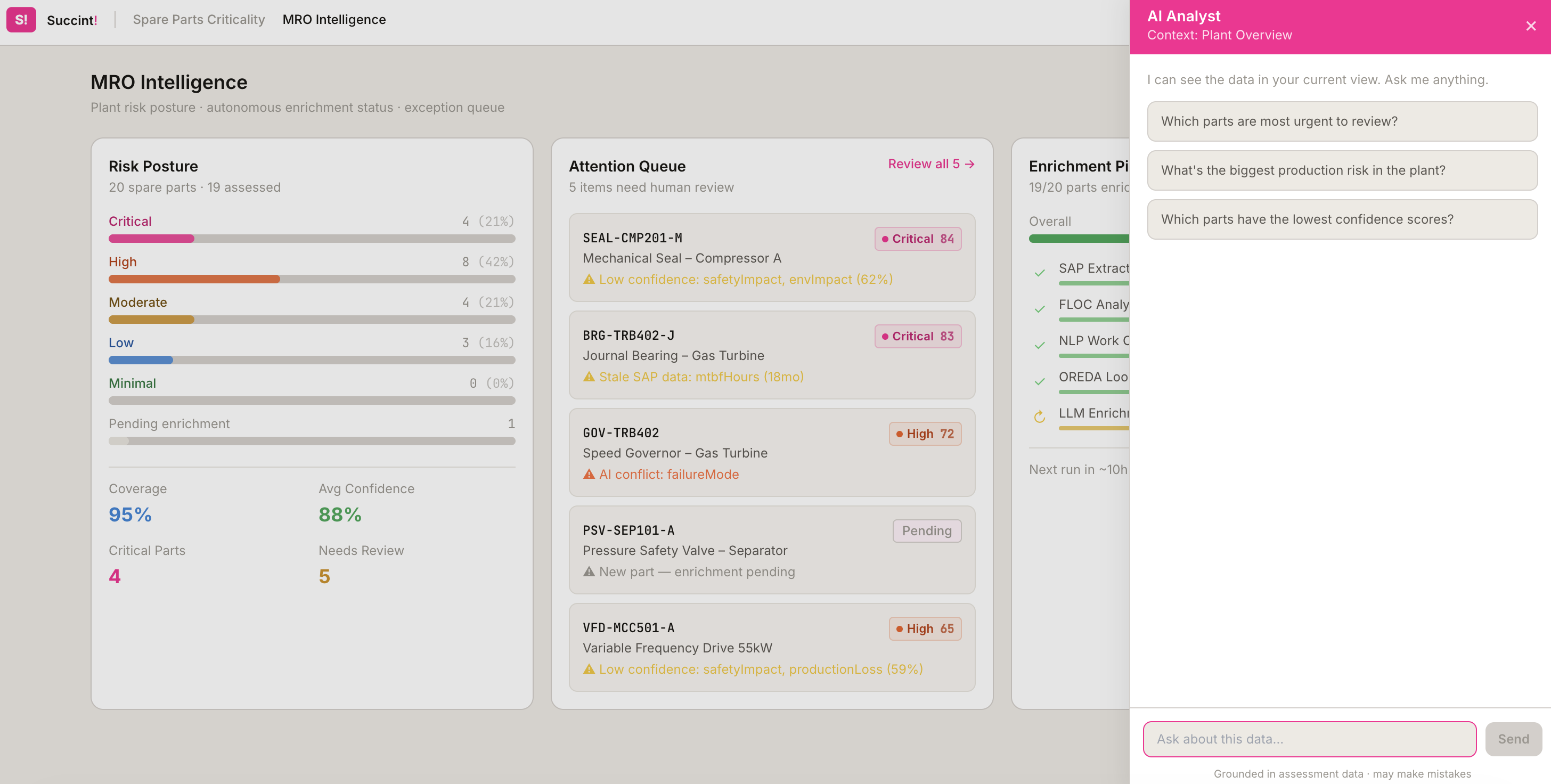
S! runs in the background of the systems your teams already open. The interface is where decisions get reviewed, approved and audited — not another dashboard to check. Most decisions never need you. When one does, it arrives in Outlook or Teams with the reasoning, the stock position and the action already attached — and when nothing needs you, S! says so and logs it.
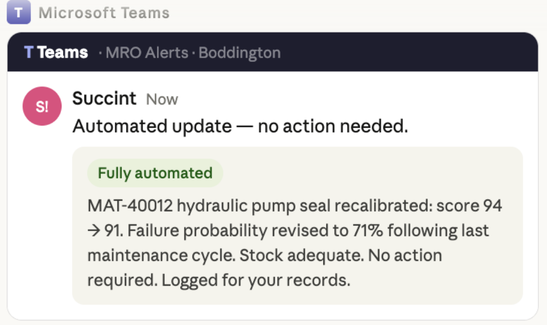
S! proposes the decision. Your team makes the call.
Every recommendation and every override is logged.S! prepares and stages the action. It executes only on your approval.
Thresholds, value limits and part classes are set by you.Rules you have already validated run without you.
You choose which decisions qualify, and you can revoke any of them.Every override is a training signal, not an exception. The system gets more right the more you correct it.
Examples from a library of eleven use cases, designed with 40+ asset-intensive operators through our co-innovation program — these are the decisions their own teams told us to automate first.
Stops the overstock / understock trade-off being made from memory.
High / Medium / Low, scored on asset criticality, downtime impact, failure probability and maintenance strategy. Re-runs as the asset base and parts lifecycle change.
Breaks sole-source dependency before it breaks your schedule.
Validated replacement parts identified across the entire asset base, not just the ones an engineer happens to remember.
No work order released without the parts to complete it.
Shutdown windows optimised around confirmed parts availability, across sites and suppliers.
Every decision logged. Every override a training signal.
We map your end-to-end MRO decision process, then run an as-is analysis of your own data: quantified potential savings, missing and incorrect data, and the use cases worth proving.
Real data, real agents, quantified savings and an in-person ROI playback. Credited in full against your first year of subscription.
Roll the validated use cases across sites, with value tracked against the baseline agreed in the proof of concept.
A quantified opportunity, traced to line items in your own data and signed off by your own team.
Each line of value gets a baseline, a named owner and a target date, agreed with finance. If a line can't be baselined, it doesn't count.
Measured against that baseline in your P&L and your inventory ledger, reported monthly. You audit the number. We don't.
We will not claim a dollar you cannot find in your own numbers.
You have. It decayed within eighteen months, because nothing kept it true. Ours re-runs on every change.
Built to plan supply, not to reason about asset risk. It consumes a criticality classification; it does not decide one.
You buy one snapshot at several times the cost, and the intelligence walks out with them at the end.
Each optimises inside one silo. Your failures happen between the silos, which is where nothing is accountable.
Eleven use cases, an MRO ontology and agent orchestration is a multi-year roadmap for a team you would have to hire first.
Without the ontology it has no map of your plant. It will answer confidently and be wrong expensively.
If you would rather co-innovate than buy: a series of free design thinking workshops, continuous prototyping side by side, and a standing invitation to co-speak at industry events. 100% free of charge. Select it as your track in the form.